Published: 1976
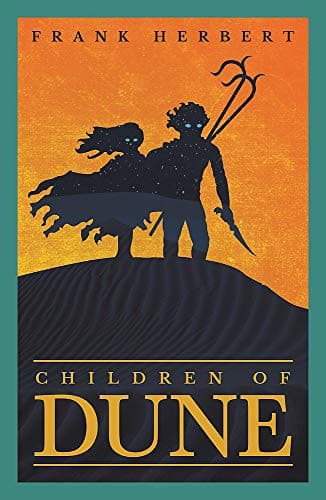
Children Of Dune
Frank Herbert
Book #3 of Dune
Key Takeaways
Children of Dune explores the long-term consequences of empire and prophecy rather than their immediate costs. The novel asks what happens when a society is frozen by a single, “perfect” vision of the future.
Power inherited is more dangerous than power seized. The Atreides legacy has become institutionalized, turning revolutionary ideals into rigid orthodoxy.
Prescience is not enlightenment but stagnation. A known future halts evolution, creativity, and moral choice.
True leadership may require becoming monstrous—or disappearing entirely.
The struggle between control and freedom defines humanity’s survival.
Overview
Children of Dune is the third novel in the Dune series and takes place roughly nine years after the death of Paul Atreides, the former Emperor Muad’Dib.
Paul’s twin children, Leto II and Ghanima Atreides, are the heirs to a vast religious empire built on their father’s legend. Though still young, they possess preternatural awareness inherited through spice exposure and Bene Gesserit breeding.
The Imperium is ruled in name by their aunt, Alia Atreides, who has succumbed to dangerous inner voices. Political factions maneuver for control, religious orthodoxy tightens, and the future of humanity itself hangs in the balance.
Unlike the rise-and-fall arc of the previous novels, Children of Dune focuses on whether history can escape the gravitational pull of prophecy.
Leto II and Ghanima: Children Beyond Childhood
Leto II and Ghanima are “pre-born,” awakened in the womb with access to ancestral memories. This makes them intellectually ancient despite their physical youth.
Ghanima learns to carefully suppress her inner voices, maintaining a fragile balance between memory and selfhood.
Leto II, however, deliberately embraces his ancestral consciousness. He studies humanity’s past and future with brutal clarity, becoming increasingly detached from ordinary human concerns.
Together, the twins understand something their father struggled with: Paul’s reign avoided immediate catastrophe, but it failed to secure humanity’s long-term survival.
Alia Atreides: The Tragedy of Possession
Alia, once revered as a living saint, rules as Regent but is slowly unraveling. Like the twins, she is pre-born—but without the discipline or restraint needed to manage her inner memories.
She becomes dominated by the personality of her grandfather, Baron Vladimir Harkonnen, whose cruelty and ambition begin to shape her actions.
Alia’s descent illustrates a core warning of the series: power without inner balance leads to self-destruction. Her rule becomes increasingly authoritarian, alienating the Fremen and destabilizing the empire.
Her fall is not caused by external enemies, but by the internal erosion of identity.
The Fremen and the Loss of a People
Once fierce desert warriors, the Fremen have become complacent beneficiaries of empire. Their culture is softened by wealth, ritual, and environmental transformation.
Arrakis itself is changing. Water spreads, sandworms decline, and the desert—the crucible of Fremen strength—is slowly disappearing.
The novel portrays cultural success as a hidden danger. The Fremen achieved their dream, but in doing so, they lost the harsh conditions that forged them.
This decline mirrors the broader stagnation of humanity under prophetic rule.
The Return of Paul Atreides
Paul, believed dead, reappears as a blind wanderer known as “The Preacher.” Stripped of power and worship, he speaks openly against the religious empire built in his name.
The Preacher denounces blind faith, challenges authority, and unsettles the political order—yet remains largely ignored or dismissed as heretical.
His presence represents a haunting truth: even when the prophet rejects godhood, the religion persists.
Paul understands that he failed to do what was necessary. His return is not an attempt to reclaim power, but a warning that humanity is still on a dangerous path.
Leto II and the Golden Path
Leto II discovers a terrifying vision of the future: without radical intervention, humanity will stagnate, fracture, and ultimately go extinct.
To prevent this, Leto conceives the Golden Path—a long-term strategy requiring absolute control, enforced peace, and the suppression of freedom for thousands of years.
Unlike Paul, Leto is willing to accept this burden fully.
He undergoes a physical transformation by merging with sandtrout, beginning his metamorphosis into a near-immortal hybrid being. This act sacrifices his humanity in exchange for longevity and invulnerability.
Leto chooses to become a tyrant so that humanity will one day be free.
Choice, Sacrifice, and Moral Horror
The novel’s central moral question is stark: Is it acceptable to commit immense evil to prevent total annihilation?
Paul could not accept this role. Leto can.
Where Paul hesitated, Leto commits. Where Paul sought to preserve his humanity, Leto abandons it entirely.
The book does not present this choice as noble or triumphant. It is portrayed as necessary, horrifying, and irreversible.
Leto’s victory is not over enemies, but over himself.
The End of Childhood and the End of Innocence
By the novel’s conclusion, Ghanima chooses a more human path, stepping away from absolute power and memory domination.
Leto, by contrast, fully embraces his destiny, setting the stage for his reign as God Emperor.
Paul dies at last, witnessing that his son has chosen the path he himself could not walk.
The Atreides legacy continues—but transformed into something colder, longer-lasting, and far more consequential.
Themes of Stagnation and Survival
Children of Dune argues that comfort is more dangerous than chaos. Societies that stop changing begin to die.
The novel reframes tyranny as a tool rather than a flaw—one that must be wielded sparingly and with full awareness of its cost.
Humanity’s greatest threat is not war, but predictability.
Freedom, Herbert suggests, cannot be preserved directly. It must sometimes be enforced through its temporary absence.
Final Insight
Children of Dune is a bridge between myth and inevitability. It closes the story of Paul Atreides while opening a far darker, longer vision for humanity.
The novel rejects simple morality. There are no heroes left—only choices with unbearable consequences.
Leto II’s decision ensures humanity’s survival, but at the price of becoming history’s greatest monster.
In the world of Dune, salvation is not gentle. It is endurance measured in millennia, paid for by one being willing to sacrifice everything—including his soul.