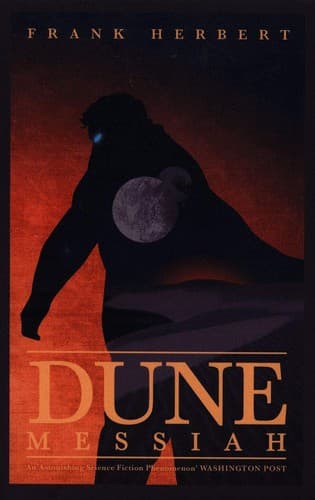
Published: 1969
Pages: 304
Dune Messiah
Frank Herbert
Book #2 of Dune
Key Takeaways
Dune Messiah examines the aftermath of absolute power rather than its rise. Victory does not bring peace; it brings responsibility, guilt, and unintended consequences.
The novel challenges the idea of the heroic savior. Even a leader with near-perfect foresight cannot escape moral compromise or historical momentum.
Religion, once unleashed, cannot be controlled. Faith transforms into fanaticism, and belief systems outgrow their creators.
Prescience is a prison. Knowing the future restricts choice, forcing individuals into paths they would otherwise reject.
Sacrifice, not domination, becomes the final form of leadership. True power may lie in letting go rather than ruling.
Overview
Dune Messiah is the second novel in the Dune series and takes place roughly twelve years after the events of Dune. Paul Atreides now rules as Emperor, known across the galaxy as Muad’Dib—a messianic figure whose rise has sparked a violent religious crusade.
This jihad has killed billions and reshaped civilization, all carried out in Paul’s name. Though he commands immense political, religious, and military power, Paul is deeply troubled by the consequences of his rule.
Rather than focusing on conquest, Dune Messiah is a quieter, darker story about the cost of prophecy, the burden of godhood, and the impossibility of moral purity in leadership.
Paul Atreides: Emperor and Prisoner
Paul possesses near-total prescient vision, allowing him to see countless possible futures. Yet this power traps him. Every attempt to avoid catastrophe only leads him closer to it.
As Emperor, Paul is worshipped as a living god. His followers interpret his words as divine truth, removing his ability to act freely or privately. Even silence becomes doctrine.
Paul understands that the jihad cannot be stopped without causing an even worse future. He remains on the throne not because he desires power, but because abandoning it would unleash greater destruction.
His rule becomes an act of endurance rather than ambition.
The Jihad and Its Moral Weight
The religious war waged in Paul’s name haunts him. Entire planets have been conquered or destroyed by fanatical armies who believe they are fulfilling divine will.
Paul never intended this outcome, yet he recognizes his complicity. His visions showed the jihad long before it occurred, and he chose the path that allowed it to happen.
The novel repeatedly asks: If you foresee a disaster and still allow it to occur, are you responsible?
Paul’s internal struggle defines the emotional core of the story.
Conspiracy Against the Emperor
A powerful conspiracy forms to overthrow Paul. It includes political rivals, religious factions, and shadowy organizations threatened by his control of the future.
Their goal is not merely to kill Paul, but to break his prescience, restoring uncertainty to the universe and freeing humanity from a single dominant vision of the future.
The conspirators understand that Paul’s greatest strength is also his greatest vulnerability.
Chani and the Question of Heirs
Paul’s concubine, Chani, is central to both his personal life and political fate. Paul knows through prescience that her death is inevitable if he produces an heir.
Yet without children, his empire will collapse into chaos after his death. Paul is forced to choose between love and legacy.
He delays this future for as long as possible, knowing that every moment of happiness with Chani shortens her life.
This conflict humanizes Paul more than any political struggle, showing that even a god-emperor cannot escape personal loss.
Blindness and Inner Vision
During a pivotal attack, Paul is physically blinded. However, his prescient abilities allow him to “see” the world through future knowledge rather than sight.
This symbolic blindness represents the novel’s central paradox: Paul sees everything, yet is increasingly unable to change anything.
As long as he can see the future, he is bound by it. His power sustains his rule, but also ensures his suffering.
Birth, Death, and Transformation
Chani eventually gives birth to twins, fulfilling the future Paul foresaw—and dies in the process.
With her death, Paul’s final emotional anchor is severed. He recognizes that continuing to rule will only perpetuate the cycle of violence and worship.
Paul chooses to abandon the throne, following ancient custom by walking into the desert blind and alone.
This act strips him of godhood and returns him to humanity, ending his reign not with conquest, but with surrender.
Themes of Power and Responsibility
Dune Messiah argues that absolute power corrupts not through cruelty, but through inevitability. Paul is not a tyrant driven by ego, but a ruler crushed by foresight and consequence.
The novel critiques messianic leadership, showing how societies project hope, fear, and obedience onto individuals—often with catastrophic results.
True freedom, the book suggests, requires uncertainty. A future that is perfectly known leaves no room for growth, choice, or moral courage.
Religion as an Uncontrollable Force
Religion in Dune Messiah has evolved beyond Paul’s influence. His image is used to justify violence, suppress dissent, and enforce obedience.
Even when Paul speaks against fanaticism, his words are reinterpreted as sacred instruction.
The story presents religion as a self-sustaining system: once belief reaches a critical mass, it no longer needs truth—or even its prophet.
Final Insight
Dune Messiah is not a traditional sequel focused on escalation. It is a philosophical reckoning with the consequences of heroism and prophecy.
The novel dismantles the idea of the chosen one, revealing that salvation narratives often replace one form of oppression with another.
Paul Atreides does not fail because he is weak or immoral—but because no single individual should control humanity’s future.
In stepping away from power, Paul commits his greatest act of leadership: allowing history to move forward without him.