Published: 1981
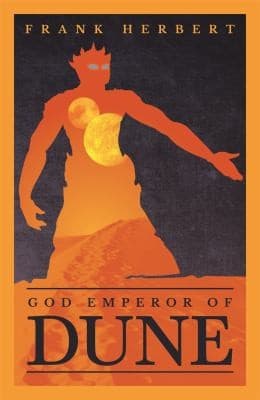
God Emperor of Dune
Frank Herbert
Book #4 of Dune
Key Takeaways
God Emperor of Dune explores the ultimate cost of enforced peace and long-term survival. The novel asks what happens when one being takes total responsibility for humanity’s future—and refuses to relinquish power for thousands of years.
Absolute control can preserve life, but it annihilates freedom.
Stagnation is more dangerous than oppression, and comfort is humanity’s greatest enemy.
True sacrifice may require becoming hated, monstrous, and inhuman.
History cannot be trusted to teach humanity—pain must be engineered into the future.
Love, loyalty, and rebellion all become tools within tyranny.
Overview
God Emperor of Dune is the fourth novel in the Dune series, set more than 3,500 years after the events of Children of Dune.
Leto II Atreides—the son of Paul Muad’Dib—now rules the known universe as the God Emperor. He is no longer human in form, having transformed into a massive, near-immortal human–sandworm hybrid. Worshiped as a living god and feared as an absolute tyrant, Leto presides over an empire locked in enforced peace.
Travel, warfare, technological innovation, and political ambition are deliberately suppressed. Humanity has known no major war for millennia.
This is not a story of rebellion triumphing over tyranny. It is a meditation on why the tyranny exists—and why it must eventually end.
Leto II: The God Emperor
Leto II possesses near-total prescient awareness, vast ancestral memory, and an iron grip on power. His body grants him physical invulnerability and a lifespan measured in thousands of years.
He controls the spice supply, making all interstellar travel dependent on his permission. He commands an all-female army, the Fish Speakers, whose loyalty is both religious and political.
Despite his godlike authority, Leto insists he is not divine—only responsible.
His rule follows the Golden Path: a long-term strategy designed to prevent humanity’s extinction by forcing it to eventually rebel, scatter, and evolve beyond centralized control.
Leto knows he must become the ultimate villain so that humanity will one day reject all such rulers forever.
A Universe Frozen in Peace
Under Leto’s reign, the Imperium has achieved total stability. There are no major wars, no competing empires, and no significant technological breakthroughs.
This peace is intentional—and dangerous.
Human ambition has dulled. Cultures stagnate. Innovation withers. Humanity grows dependent, passive, and obedient.
Leto views this decay as necessary. By denying humanity struggle, he ensures that when freedom finally returns, it will be seized with uncontrollable force.
The empire is not meant to thrive—it is meant to suffocate, preparing the conditions for explosive change.
The Role of Rebellion
Throughout the novel, multiple conspiracies attempt to assassinate Leto. These rebellions are not only tolerated—they are subtly encouraged.
Leto manipulates rebels, courts them, frustrates them, and ultimately allows them to fail. Each rebellion reinforces humanity’s instinct to resist domination.
He does not fear assassination. In fact, his long-term plan requires it.
Rebellion, for Leto, is humanity’s most vital trait. His tyranny exists to sharpen that instinct, not erase it.
Duncan Idaho: Eternal Witness
Leto repeatedly resurrects Duncan Idaho through ghola technology, creating countless versions over centuries. Each Duncan serves as an advisor, companion, and eventual traitor.
Duncan represents humanity’s unchanging core: instinctive morality, resistance to tyranny, and emotional authenticity.
Every Duncan eventually rebels against Leto—and must be killed.
Rather than seeing this as failure, Leto views it as proof that humanity still possesses the capacity for outrage and independence.
Duncan is not meant to succeed. He is meant to remain human, even when humanity itself forgets how.
Hwi Noree and the Possibility of Love
Hwi Noree is a gentle, empathetic figure engineered to inspire love and loyalty. Leto becomes emotionally attached to Hwi—perhaps the closest thing he has to love in millennia.
This relationship exposes Leto’s greatest vulnerability: his lingering humanity.
Hwi’s presence softens Leto, making him momentarily careless. That weakness becomes a critical element in the unfolding conspiracy.
Through Hwi, the novel asks whether love can exist within absolute power—or whether it inevitably destabilizes it.
The Conspiracy and the End of the Tyrant
A coalition of rebels, including Duncan, the Bene Gesserit, and others, finally succeeds in killing Leto.
His death is not a failure of the Golden Path—it is its fulfillment.
As Leto’s body disintegrates, sandworms are released back into the ecosystem, ensuring the continuation of spice production without centralized control.
Humanity is forced into a new era of uncertainty, migration, and decentralization—the very chaos Leto engineered.
His death marks the beginning of The Scattering, where humanity spreads beyond the reach of any single ruler or prophecy.
The Golden Path Realized
Leto’s tyranny was never meant to last forever. It was designed to be so oppressive, so absolute, that humanity would never allow such a figure to rise again.
By enduring millennia of stagnation, humanity becomes violently allergic to control.
The future Leto creates is unpredictable, diverse, and impossible to dominate.
In sacrificing himself—and forcing humanity to hate him—Leto ensures that extinction through stagnation can never occur.
Themes of Power, Memory, and Responsibility
God Emperor of Dune reframes tyranny as a preventative measure, not a moral failing.
The novel challenges the idea that freedom is humanity’s natural state. Instead, it suggests freedom must be learned through suffering.
Memory becomes both a weapon and a burden. Leto remembers everything so that humanity does not have to—and cannot.
Leadership, taken to its extreme, becomes indistinguishable from monstrosity.
Final Insight
God Emperor of Dune is the philosophical core of the Dune saga. It abandons traditional narrative tension in favor of reflection, dialogue, and moral extremity.
Leto II is not a hero, martyr, or villain in the conventional sense. He is a system, designed to destroy itself.
His reign proves that the greatest danger to humanity is not chaos or violence—but safety without choice.
In the end, Leto gives humanity the greatest gift imaginable: a future where no one like him can ever rule again.