Published: 2016
Pages: 212
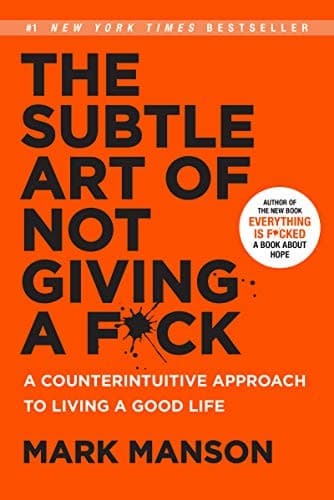
The Subtle Art of Not Giving a F*ck: A Counterintuitive Approach to Living a Good Life
Mark Manson
Book #1 of The Subtle Art of Not Giving a F*ck
Key Takeaways
Choosing What to Care About
Life is finite, and so is the energy we have to give. Mark Manson argues that the key to a good life is not caring about more things, but caring about fewer things — and choosing them wisely. Most of our suffering comes from giving too many f*cks about things that ultimately don't matter.
Pain Is Part of the Process
Avoiding pain is not the goal. Every worthwhile pursuit involves struggle and difficulty. The real question is not "How do I avoid problems?" but "What problems am I willing to endure?" Your answer to that question determines the shape of your life.
You Are Not Special
Modern culture insists on telling everyone they are exceptional. Manson pushes back hard. Most of us are average at most things, and accepting that is liberating rather than defeating. Entitlement — the belief that you deserve good things without effort — is a significant source of modern misery.
Responsibility vs. Fault
You may not be at fault for everything that happens to you, but you are always responsible for how you respond. Taking radical ownership of your reactions, choices, and attitudes is the foundation of genuine growth — even when circumstances are genuinely unfair.
Values Determine Everything
Bad values lead to bad problems. Good values lead to good problems. Manson argues that most self-help fails because it focuses on goals rather than values. Sustainable improvement requires examining what you actually care about and whether those things are worth caring about.
Main Ideas
The central argument of the book is a paradox: the desire to feel good all the time is itself a significant source of unhappiness. By constantly chasing positivity and avoiding discomfort, people deny themselves the experiences that build meaning, resilience, and genuine satisfaction. Manson draws on Stoic philosophy, psychology, and blunt personal anecdote to make the case that embracing limitation — in what you pursue, what you feel, and what you expect — is the path to a better life.
The Feedback Loop from Hell
Manson introduces the idea of the "feedback loop from hell": feeling anxious about being anxious, feeling guilty about feeling guilty, feeling bad about feeling bad. Modern life, especially social media, amplifies this by constantly presenting curated images of happiness that make ordinary struggle feel like failure. The solution is not to eliminate negative emotion but to stop treating it as a problem that needs to be fixed.
The Subtle Art Itself
Not Giving a F*ck Does Not Mean Indifference
Manson is careful to clarify his title. Not giving a f*ck does not mean caring about nothing. It means being deliberate and selective about what you care about, and developing the ability to tolerate discomfort in service of those things. Indifference is easy and empty. Selectivity is difficult and meaningful.
Subtlety Requires Maturity
Young people often give too many f*cks — about popularity, approval, image. Mature people learn to let most of that go. The art is subtle because it takes experience to know which things deserve your emotional investment and which do not.
The Three Layers of Self-Awareness
Manson describes three questions necessary for understanding your own values and motivations.
What Do You Feel?
Most people can answer this. Emotions are the surface layer and the easiest to identify.
Why Do You Feel It?
This is harder. What values and beliefs are producing these emotions? What do you think is being gained or lost?
Are Your Values Useful?
This is the deepest and most uncomfortable question. Are the things you care about actually making your life better, or are they a source of endless dissatisfaction?
Good and Bad Values
Bad Values
Bad values are typically pleasure-seeking, status-driven, or based on external validation. Examples include always being right, staying comfortable, being liked by everyone, or accumulating wealth as an end in itself. These values are problematic because they cannot be reliably achieved and depend on factors outside your control.
Good Values
Good values are process-oriented and internally measured. Examples include honesty, creativity, vulnerability, and contributing to others. These values are worth pursuing because progress is always possible regardless of external circumstances.
The Importance of Saying No
Manson argues that genuine commitment requires rejection. Choosing one path means not choosing others. A life without boundaries — where you try to please everyone, pursue every opportunity, and avoid all conflict — is a life that stands for nothing. Healthy relationships, meaningful work, and genuine identity all depend on the ability to say no clearly and without guilt.
Death as Motivation
In the final section of the book, Manson turns to mortality. Drawing on philosopher Ernest Becker's work, he argues that awareness of death is one of the most powerful motivators available to human beings. Most of what people do — building legacies, having children, seeking fame — is an attempt to achieve symbolic immortality, to matter beyond their own brief existence. Accepting death rather than fleeing from it clarifies what truly deserves your limited time and attention.
The "Do Something" Principle
Motivation does not precede action. Action precedes motivation. Manson inverts the conventional advice to wait until you feel ready or inspired. Instead, he argues that doing something — anything — generates momentum, which generates emotion, which generates more action. The simplest antidote to paralysis is to start, even badly.
Final Insight
The Subtle Art of Not Giving a F*ck is a counterintuitive guide to living well by caring less about the wrong things. Manson's core message is that life's struggles are not obstacles to meaning — they are the source of it. Choosing your problems wisely, accepting your ordinariness, and committing to values over feelings are the unglamorous but reliable foundations of a life worth living.