Published: 2019
Pages: 288
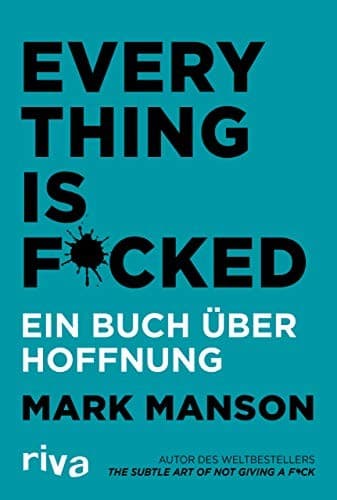
Everything Is F*cked
Mark Manson
Book #2 of The Subtle Art of Not Giving a F*ck
Key Takeaways
Hope Is the Engine, Not the Destination
Hope is not a feel-good emotion — it is the psychological fuel that keeps people functioning. Without a believable vision of a better future, the human mind stalls out into anxiety, depression, and paralysis. The question is not whether to have hope, but whether the hope you have is built on something real and sustainable.
The Paradox of Progress
By virtually every measurable standard, the world is better than it has ever been — less poverty, less violence, longer lives, more freedom. Yet rates of depression and anxiety are rising. Manson argues this is not a contradiction but a consequence: the better life gets, the less we have to struggle against, and the less we have to hope for.
The Thinking Brain vs. The Feeling Brain
Humans like to believe they are rational creatures who occasionally feel emotions. The reality is the opposite. Feelings drive decisions, and the rational mind spends most of its time constructing justifications after the fact. Understanding this is the first step to genuine self-awareness and lasting change.
Values Over Feelings
The path forward is not to feel better — it is to act better. Manson argues that a life built around the pursuit of good feelings is inherently unstable. A life built around clearly held values is resilient, because it does not depend on external circumstances going your way.
Act Without Hope
The most counterintuitive conclusion in the book: the highest form of human action is to do what is right without needing the promise of a better outcome. True maturity means acting on your values simply because they are your values — not because you expect to be rewarded.
Main Ideas
Where The Subtle Art of Not Giving a Fck* focused on the individual — what you care about, how you suffer, what values you hold — Everything Is Fcked* zooms out to the collective. It asks why modern societies, despite unprecedented comfort and freedom, feel so broken and hopeless. Drawing on psychology, philosophy, and history, Manson examines hope itself as both humanity's greatest strength and one of its most dangerous vulnerabilities.
The Uncomfortable Truth
Manson opens with an existential provocation: the universe is indifferent. Life has no inherent meaning. Everything will eventually end and be forgotten. This is what he calls the Uncomfortable Truth. Most human behavior, he argues, is an elaborate attempt to avoid confronting it — through religion, ideology, consumerism, social media, and the endless pursuit of self-improvement. Rather than offering comfort, Manson insists that accepting the Uncomfortable Truth is the only honest starting point for a meaningful life.
The Thinking Brain and the Feeling Brain
The Feeling Brain
The Feeling Brain is ancient, fast, and emotional. It processes experience through sensation and intuition. It is the part of you that reacts before you think and that ultimately decides what you care about.
The Thinking Brain
The Thinking Brain is rational, analytical, and slow. It constructs arguments, plans ahead, and explains the world in logical terms. The problem is that it largely operates in service of the Feeling Brain — rationalizing what the emotions have already decided.
The Implication
Lasting change cannot come from logic alone. To change behavior, you must change what you feel, which means changing what you value. Telling yourself to do the right thing is rarely enough; the Feeling Brain must be brought along through consistent action and lived experience.
Newton's Laws of Emotion
In one of the book's most original sections, Manson applies Newton's three laws of motion as a metaphor for emotional and psychological life.
The First Law: An object in motion stays in motion
Emotional states persist until something disrupts them. Pain and hope are both self-reinforcing. Most people wait to feel ready before acting — but readiness is itself an emotional state that must be generated through action, not waited for.
The Second Law: Force equals mass times acceleration
The bigger and more entrenched a belief system, the more force it takes to change it. Small interventions rarely shift large worldviews.
The Third Law: Every action produces an equal and opposite reaction
Every attempt to fix the world creates new problems in its place. The solution to one crisis seeds the conditions for the next. This is not a reason for despair — it is a reason for humility.
The Formula for Hope
Manson argues that hope requires three things to survive.
A Sense of Control
People need to believe that their actions influence their circumstances. Remove that belief and motivation collapses entirely.
A Sense of Values
People need something worth pursuing — something that feels meaningful enough to justify the effort and discomfort involved.
A Community
People need others who share their values and reinforce their sense of purpose. Isolated individuals cannot sustain hope alone for long.
Lose any one of these three and hope begins to erode.
Religion, Ideology, and the Problem of Blind Faith
Manson examines how both religion and political ideology function as hope-generating systems. Both offer community, values, and a sense that individual action contributes to something larger. Both also carry the same inherent risk: when taken too far, they demand the suppression of doubt, the vilification of outsiders, and the subordination of evidence to belief. The internet, Manson argues, has become a secular religion of its own — offering meaning, tribe, and moral certainty while demanding outrage and conformity in return.
The Dangers of Too Much Hope
One of the book's most striking arguments is that hope itself can become destructive. When people attach their emotional wellbeing to a specific outcome — a political victory, a personal achievement, a movement's success — any setback becomes catastrophic. The more desperately someone needs the future to look a certain way, the more fragile and volatile their behavior becomes. Fanatics of all kinds are people whose hope has become so rigid that they would rather destroy than revise it.
Heroism Without Hope
The book's moral center is the story of Witold Pilecki, a Polish soldier who voluntarily entered Auschwitz in order to organize a resistance from within. Pilecki had no guarantee that his actions would matter. He acted anyway, on the basis of his values alone, without any promise of success or survival. Manson uses this story to illustrate what he considers the highest form of human courage: the ability to do what is right in the absence of any assurance that it will work.
Final Insight
Everything Is Fcked is ultimately a book about growing up — as individuals and as a civilization. The childish version of hope says: things will get better, and then I will be happy. The mature version says: things may or may not get better, and I will act well regardless. Manson's challenge is to stop treating hope as a destination and start treating values as the foundation — because a life built on what you do, rather than what you expect, is the only kind that can survive contact with reality.