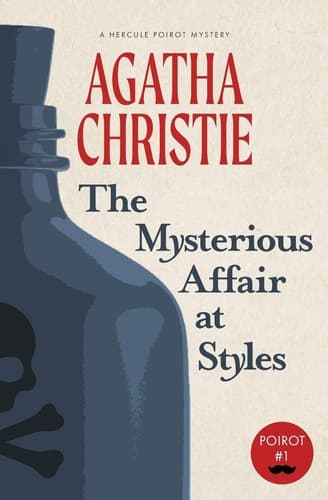
The Mysterious Affair at Styles
Agatha Christie
Book #1 of Hercule Poirot
Key Takeaways
The Mysterious Affair at Styles introduces Hercule Poirot, Agatha Christie’s famous Belgian detective, and establishes many of the conventions of the classic English murder mystery. The novel centers on logic, careful observation, and psychological insight rather than action.
The story demonstrates that truth is often hidden behind appearances. Motives, relationships, and seemingly insignificant details play a critical role in uncovering the crime.
Justice in the novel comes not from force, but from intellect. Poirot’s methodical reasoning shows how patience and analytical thinking can reveal even the most carefully concealed wrongdoing.
The book also explores themes of inheritance, jealousy, love, and betrayal, showing how personal emotions can drive people to extreme actions.
Overview of the Story
Set during World War I in the English countryside, the novel follows Captain Arthur Hastings, a wounded officer recovering at Styles Court, the country estate of the wealthy Emily Inglethorp. When Emily dies suddenly under suspicious circumstances, Hastings turns to his old friend Hercule Poirot to solve the mystery.
What appears at first to be a straightforward poisoning soon becomes a complex puzzle involving family tensions, romantic entanglements, and deliberate deception.
Setting and Atmosphere
Styles Court is a quiet country house, isolated yet filled with emotional undercurrents. The setting reflects the classic “closed circle” mystery, where a limited number of suspects all have access, opportunity, and potential motives.
The wartime backdrop subtly heightens the sense of uncertainty and disruption, while the peaceful rural environment contrasts sharply with the crime that occurs within it.
The Central Crime
Emily Inglethorp dies after suffering violent convulsions, and it is quickly determined that she was poisoned with strychnine. The challenge lies in understanding how the poison was administered, since her medicine appears harmless and no one admits to tampering with it.
Suspicion falls on several people, including Emily’s much younger husband Alfred Inglethorp, whose inheritance would be greatly increased by her death.
The Key Characters
Each resident or visitor at Styles has something to hide. Alfred Inglethorp appears controlling and secretive. Emily’s stepsons, John and Lawrence Cavendish, face financial uncertainty. Mary Cavendish’s behavior suggests emotional conflict. Cynthia Murdoch, who works at a nearby hospital, has access to drugs and chemicals.
Poirot treats every character as a potential suspect, emphasizing that guilt is determined by evidence, not by outward impressions.
Poirot’s Method
Hercule Poirot relies on what he calls “the little grey cells.” Rather than chasing suspects or searching for dramatic clues, he focuses on inconsistencies, timelines, and human psychology.
He pays close attention to minor details—such as the handling of a medicine bottle or the timing of events—that others dismiss as trivial. Poirot also allows suspects to reveal themselves through their words and behavior.
Deception and False Trails
A major element of the novel is misdirection. Characters deliberately create false impressions, and some evidence is designed to point investigators toward the wrong conclusion.
The reader is encouraged to suspect multiple characters, only to discover that assumptions based on emotion or prejudice can be misleading. Christie carefully balances clues and red herrings, making the solution logical but not obvious.
The Revelation
In the final act, Poirot gathers everyone together and explains the crime step by step. The murder was not a crime of passion, but a calculated plan involving manipulation, chemistry, and timing.
The true culprit exploited trust, legal loopholes, and assumptions about intelligence and class. Poirot exposes not only how the murder was committed, but why it succeeded for so long without detection.
Themes and Ideas
The novel explores the danger of underestimating others. Poirot, often dismissed because of his appearance and manners, proves far more perceptive than the official investigators.
It also highlights how greed and resentment can corrupt relationships, especially when money and inheritance are involved.
Order and reason ultimately triumph over chaos. The restoration of truth brings moral balance back to Styles Court.
Final Insight
The Mysterious Affair at Styles is both a compelling murder mystery and a foundation for the modern detective genre. It showcases Agatha Christie’s talent for intricate plotting and fair-play puzzles, while introducing a detective whose intellect and personality would become iconic. The novel invites readers to think critically, question assumptions, and appreciate the power of careful reasoning in the search for truth.