Published: 2024
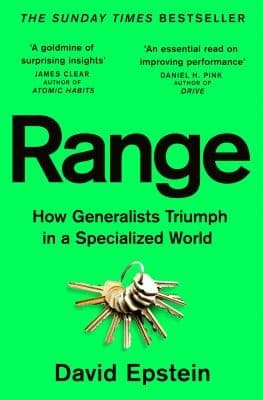
Range
David Epstein
Key Takeaways
Range: Why Generalists Triumph in a Specialized World argues that broad experience, diverse skills, and delayed specialization often lead to greater long-term success than early, narrow focus. In many complex and unpredictable fields, generalists outperform specialists.
Learning across multiple domains improves adaptability. Exposure to different disciplines allows people to recognize patterns, transfer knowledge, and solve problems more creatively than those trained in a single track.
Early specialization is only advantageous in highly predictable environments. In fields with stable rules and immediate feedback, specialization works well. In most real-world contexts, however, complexity favors range.
Struggle and inefficiency during learning are not signs of failure, but indicators of deeper understanding. Slower, exploratory learning produces more flexible and durable skills.
Modern success increasingly depends on the ability to integrate ideas rather than optimize a single skill. The ability to connect concepts across domains is a competitive advantage.
Main Ideas
The book challenges the cultural belief that success requires early focus, specialization, and linear career paths. Through research, case studies, and scientific evidence, it demonstrates that generalists often excel when problems are complex, evolving, and ambiguous.
The author contrasts narrow optimization with broad exploration, showing that many high achievers follow winding paths that build diverse skill sets before finding their strengths.
Early Specialization Versus Sampling
The book begins by comparing early specialization with early sampling. Early specialization involves choosing a single path at a young age and pursuing it intensively. Early sampling involves trying many activities before committing.
In predictable fields with fixed rules, such as chess or certain sports, early specialization can lead to early mastery. However, most professional and creative domains do not follow this pattern.
Sampling allows individuals to develop a broader set of skills, interests, and perspectives. This exploration often leads to better long-term fit, higher motivation, and greater resilience.
The Power of Transfer Learning
A central concept in the book is transfer, the ability to apply knowledge from one domain to another. Transfer enables people to solve unfamiliar problems by recognizing similarities across contexts.
Generalists are more likely to engage in transfer because they possess knowledge from multiple domains. This allows them to draw analogies, combine ideas, and approach problems from unconventional angles.
Specialists may excel in narrow tasks but struggle when problems change or require cross-disciplinary thinking.
Kind Versus Wicked Learning Environments
The book distinguishes between kind and wicked learning environments. Kind environments have clear rules, stable patterns, and immediate feedback. Wicked environments are unpredictable, with delayed or incomplete feedback.
Specialization works well in kind environments. Wicked environments, which characterize most real-world careers, reward adaptability, experimentation, and breadth of experience.
Understanding the nature of the environment is critical when deciding whether to specialize early or cultivate range.
The Role of Struggle in Learning
The book challenges the idea that fast learning is better learning. It shows that desirable difficulties, such as slower progress, confusion, and varied practice, often lead to deeper understanding.
Generalists frequently experience early inefficiency because they explore multiple paths. However, this struggle builds cognitive flexibility and prepares them to handle novel challenges later.
Learning that feels harder tends to produce more transferable knowledge.
Career Paths and Late Bloomers
Many successful individuals discover their strengths later in life after experimenting with multiple careers or disciplines. The book highlights that nonlinear career paths are common among innovators and leaders.
Generalists benefit from delayed commitment because it allows interests and abilities to emerge organically. When commitment finally occurs, it is often more informed and sustainable.
Late bloomers are not behind; they are accumulating hidden advantages through exploration.
Innovation Through Integration
Innovation often occurs at the intersection of fields. By combining ideas from different disciplines, generalists create solutions that specialists may overlook.
The book emphasizes that breakthroughs frequently come from outsiders who apply unfamiliar perspectives to established problems.
Range enables synthesis, which is increasingly valuable in a world where information is abundant but insight is scarce.
Education and Modern Work
The book critiques education and training systems that push early specialization without regard for individual development or environmental complexity.
It argues for educational approaches that encourage exploration, interdisciplinary learning, and long-term development rather than premature narrowing.
In modern work environments, where roles evolve rapidly, the ability to learn, adapt, and integrate knowledge is more important than mastering a single static skill.
Final Insight
Range presents a powerful counterpoint to the specialization mindset. Its central message is that breadth is not a weakness but a strength in complex, changing worlds. By exploring widely, embracing struggle, and integrating knowledge across domains, generalists develop adaptability, creativity, and long-term success. The book reframes nonlinear paths not as detours, but as essential preparation for meaningful and resilient achievement.