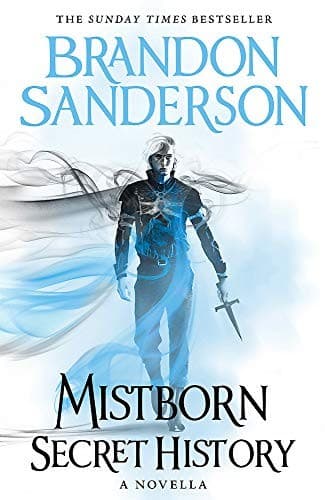
Published: 2019
Mistborn: Secret History
Brandon Sanderson
Key Takeaways
Mistborn: The Final Empire introduces a richly structured fantasy world ruled by oppression, where a small group of rebels challenges an immortal tyrant believed to be invincible. The novel blends epic fantasy with a heist narrative, focusing on trust, belief, and the cost of hope.
The story centers on Allomancy, a unique magic system in which certain individuals can ingest and “burn” metals to gain specific powers. This system shapes politics, warfare, and social hierarchy.
Power is sustained not only through force, but through fear, mythology, and control of information. The Lord Ruler’s dominance endures because people believe resistance is futile.
The novel explores transformation—personal, social, and ideological. Characters evolve from survivors into leaders, and from cynics into believers.
Hope is portrayed as dangerous but necessary. While rebellion risks catastrophic failure, the absence of hope guarantees continued suffering.
Setting: The Final Empire
The story takes place in the Final Empire, a bleak world where ash constantly falls from the sky and the sun appears red. This environment reflects the political reality: stagnation, decay, and despair.
Society is rigidly divided. The noble class descends from those who supported the Lord Ruler a thousand years earlier, while the skaa—an enslaved underclass—endure brutal exploitation. Skaa are beaten, worked to death, and denied education to prevent organized resistance.
The Lord Ruler is worshiped as a god-emperor. He is said to be immortal, having ruled for a millennium, and his regime is enforced by obligators (bureaucrats and priests) and Steel Inquisitors—terrifying enforcers empowered by dark forms of Allomancy.
Allomancy: The Magic System
A defining feature of the novel is Allomancy. Certain people, called Mistings, can burn one metal to gain a specific power, such as enhanced strength, emotional manipulation, or heightened senses.
Mistborn are extremely rare individuals who can burn all Allomantic metals, making them exceptionally powerful. Allomancy is inherited and tightly controlled by the nobility.
The precision and limitations of Allomancy give the story a grounded, almost scientific structure. Power requires preparation, resources, and knowledge, reinforcing the theme that strength comes from discipline and understanding rather than destiny alone.
Kelsier: The Survivor
Kelsier is a charismatic thief and rare Mistborn who becomes the catalyst for rebellion. Once imprisoned in the Pits of Hathsin—a death sentence for skaa—he survived and gained his powers there, earning the title “Survivor.”
Unlike previous rebels, Kelsier believes hope itself is a weapon. He spreads legends about himself to inspire the skaa, deliberately cultivating a myth that resistance is possible.
However, Kelsier is not purely idealistic. He is driven by personal trauma and hatred of the Lord Ruler, and his willingness to manipulate symbols and people raises questions about leadership, sacrifice, and moral cost.
Vin: From Survivor to Hero
Vin begins the story as a deeply mistrustful street urchin who has been abused and betrayed throughout her life. She survives by expecting the worst from everyone.
Kelsier recruits Vin into his crew after discovering she is a Mistborn. Under his guidance, she learns Allomancy and begins to experience trust, belonging, and self-worth for the first time.
Vin’s arc is central to the novel. She struggles between her instinct to hide and the growing realization that she can be something more. Her journey is not just about gaining power, but about choosing belief—both in others and in herself.
The Crew and the Heist
At its core, The Final Empire is structured like a heist story. Kelsier assembles a crew of specialists, each with a defined role: planners, fighters, spies, and Allomancers.
Their plan is not simply to steal wealth, but to collapse the empire from within. They aim to undermine the economy, incite rebellion, and ultimately confront the Lord Ruler himself.
This structure allows the story to explore teamwork, trust, and strategy. No single character can succeed alone; victory depends on coordination and shared purpose.
The Nobility and Political Infiltration
Vin is trained to infiltrate noble society under a false identity. Through her interactions with young nobles, particularly Elend Venture, the story complicates the simplistic division between oppressor and oppressed.
Elend is idealistic, questioning the morality of the empire and dreaming of reform rather than domination. His presence challenges Vin’s assumptions and introduces themes of political philosophy, governance, and responsibility.
These sections highlight that systems of oppression persist not only because of cruelty, but also because of complacency and inherited power structures.
Religion, Myth, and Control
Religion plays a central role in maintaining the Final Empire. The Lord Ruler’s divinity is reinforced through ritual, fear, and selective history.
Kelsier deliberately mirrors this by creating counter-myths. He becomes a symbol larger than himself, understanding that people need stories to rally behind.
The novel repeatedly asks whether belief is more powerful than truth, and whether lies can be justified if they inspire liberation.
The Lord Ruler Revealed
As the rebellion unfolds, the crew learns more about the Lord Ruler’s past. He was once a man who took power to stop an apocalyptic threat, but became corrupted by absolute authority.
When he finally confronts Vin, he is revealed not as an untouchable god, but as a deeply flawed, tyrannical ruler sustained by specific magical mechanisms.
His defeat comes not through brute force alone, but through understanding the systems that empower him—reinforcing the book’s emphasis on knowledge as power.
Sacrifice and Consequences
Victory is not clean or easy. The rebellion succeeds at enormous cost, including the loss of central characters and the shattering of long-held illusions.
Kelsier’s fate cements him as a martyr, transforming his message into something that survives beyond his life. His sacrifice forces Vin and others to step into leadership roles they never wanted.
The novel makes clear that overthrowing tyranny does not end suffering instantly. Change is fragile, uncertain, and demands responsibility.
Final Insight
Mistborn: The Final Empire combines meticulous worldbuilding with a deeply human story about belief, trust, and transformation. It argues that systems of power endure because people believe they must, and that change begins when that belief cracks.
Through Vin’s growth, Kelsier’s defiance, and the collapse of an immortal empire, the novel reframes heroism as a choice rather than a destiny. Hope, though dangerous, becomes the most powerful force of all—not because it guarantees success, but because without it, resistance is impossible.