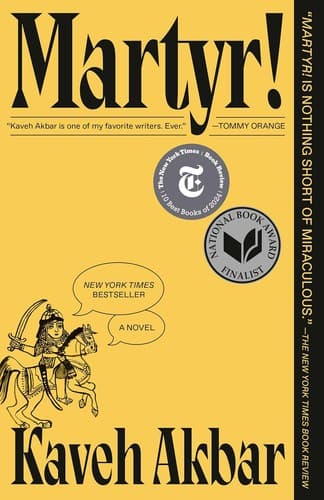
Published: 2025
Pages: 352
Martyr!
Kaveh Akbar
Key Takeaways
Martyr! is a contemporary literary novel about grief, faith, addiction, and the longing to live a meaningful life in a world shaped by violence and displacement. It follows a young Iranian American man searching for purpose after profound personal loss.
The novel explores martyrdom not as heroic sacrifice, but as an everyday temptation: the desire to disappear, to suffer meaningfully, or to turn pain into moral significance.
Identity is portrayed as fractured and unstable. The protagonist moves between cultures, histories, and belief systems without fully belonging to any of them.
Language, poetry, and art are presented as both refuge and risk—tools that can heal but also romanticize suffering.
The book argues that survival itself, with all its compromises and messiness, may be the most radical act of defiance.
Overview
Martyr! centers on Cyrus Shams, a young Iranian American poet living in the United States. He is sober, lonely, grieving, and spiritually restless. His father died years earlier, and his mother was killed when the plane she was on was shot down by a U.S. warship—a historical tragedy that haunts the novel.
Cyrus is obsessed with death, meaning, and martyrdom. He keeps a private list of “martyrs,” ranging from political figures to artists and addicts, people whose suffering he believes gave their lives coherence. The novel follows his interior journey as much as its external events, moving through memory, fantasy, poetry, and history.
Cyrus Shams: A Life Shaped by Loss
Cyrus is defined by absence. His parents’ deaths leave him unmoored, struggling with addiction and depression. Sobriety does not bring clarity so much as raw exposure to grief he once numbed.
He is deeply intellectual and self-aware, yet emotionally stuck. He longs for transcendence but feels trapped in banality. His fixation on martyrdom becomes a way to impose narrative order on chaos—to believe that suffering can be transformed into something noble or beautiful.
Martyrdom as an Obsession
The concept of martyrdom runs throughout the novel in religious, political, and personal forms. Cyrus is drawn to figures who died for causes, art, or belief, but he also questions whether this attraction is a disguised death wish.
The book challenges romantic ideas of sacrifice. It asks whether glorifying pain is a way of avoiding the harder work of living, loving, and accepting ambiguity.
Martyrdom is shown not as clarity, but as seduction.
History, Politics, and Inherited Trauma
The shooting down of Iran Air Flight 655—based on a real historical event—anchors the novel in geopolitical violence. Cyrus’s mother becomes both a personal loss and a symbol of how ordinary lives are erased by global power.
The novel explores how political trauma reverberates across generations, shaping identity even when the events themselves are half-known or poorly understood.
Cyrus carries a grief that is both intimate and historical, personal and collective.
Art, Poetry, and Meaning
Poetry is central to the novel’s structure and themes. Cyrus believes art can redeem suffering, yet he also fears that turning pain into poetry may exploit it.
The book wrestles with the ethics of art-making:
- Does art honor pain or aestheticize it?
- Can beauty emerge without betrayal?
Language is lush, experimental, and often surreal, mirroring Cyrus’s unstable inner world.
Relationships and Isolation
Cyrus’s relationships are tentative and fragile. He longs for intimacy but struggles to remain present. Conversations drift into philosophy, memory, or fantasy, reflecting his difficulty with ordinary connection.
Other characters act as mirrors rather than solutions, revealing different ways of surviving loss without resolving Cyrus’s central conflict.
Loneliness is not cured by understanding; insight does not equal healing.
Spiritual Longing Without Certainty
Although the novel is saturated with religious imagery, it resists clear belief. Cyrus is drawn to faith but unable to surrender to it fully.
Spirituality appears as yearning rather than doctrine—a hunger for meaning without the comfort of answers.
The novel suggests that doubt may be more honest than certainty, and questioning more human than belief.
Living Versus Being Remembered
A central tension in the book is the desire to be remembered versus the responsibility to stay alive. Cyrus fears that an ordinary life is a wasted one, yet he slowly confronts the possibility that meaning does not require spectacle.
The novel reframes heroism as endurance. Choosing to live, imperfectly and without guarantees, becomes an act of courage.
Style and Structure
The narrative blends realism with dreamlike sequences, lists, poetic fragments, and historical digressions. This fragmented structure reflects Cyrus’s mental state and the nonlinear nature of grief.
The prose is lyrical, darkly funny, and emotionally intense, often shifting registers within a single page.
Final Insight
Martyr! is a meditation on how people survive unbearable loss without turning their lives into monuments to pain. It rejects easy redemption and instead offers a quieter truth: meaning may not come from sacrifice, clarity, or legacy, but from the ongoing, difficult choice to remain alive.
The novel ultimately asks whether living—without guarantees of purpose or transcendence—is enough. It suggests that it might be.