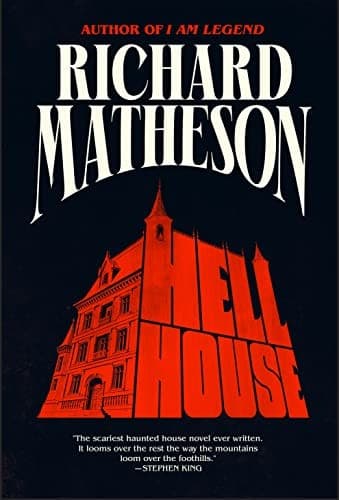
Published: 2023
Hell House
Richard Matheson
Key Takeaways
Hell House presents evil as an active, conscious force rather than a psychological illusion. The novel argues that some forms of malevolence are external, intelligent, and intentionally destructive.
Rationalism alone is insufficient when confronting phenomena that defy logic. Characters who rely exclusively on scientific skepticism are as vulnerable as those who rely solely on faith.
Human weakness amplifies supernatural power. The house feeds on fear, repression, guilt, and obsession, suggesting that evil gains strength through human psychological fractures.
Sexual repression and moral hypocrisy are depicted as corrosive forces. The novel links denial of desire and shame to violence, corruption, and spiritual decay.
Survival depends on balance. Neither belief nor disbelief is enough on its own; understanding requires confronting both psychological and supernatural realities simultaneously.
Main Ideas
The novel follows a team assembled to investigate a notoriously haunted mansion with the goal of proving the existence and nature of life after death. Each member represents a different approach to the paranormal, including scientific skepticism, spiritual belief, and emotional sensitivity.
As the investigation progresses, the house actively attacks the investigators, exploiting their fears and desires. The story becomes a confrontation not just with a haunted location, but with the investigators’ inner vulnerabilities.
The House as an Antagonist
Belasco House is portrayed as a living entity rather than a passive setting. Its history of cruelty, excess, and moral corruption saturates the space with malevolent energy.
The house does not merely frighten its occupants; it studies them, isolates them, and targets their weaknesses. This intelligence elevates the horror from haunting to predation.
The structure itself becomes a symbol of accumulated human depravity, preserved and weaponized against those who enter.
Science Versus Belief
The investigation team embodies conflicting worldviews. One character insists on scientific explanation and technological measurement, rejecting all spiritual interpretations. Another believes that the phenomena are evidence of surviving consciousness after death.
The novel critiques both extremes. Scientific denial blinds characters to real danger, while unexamined belief exposes others to manipulation.
Truth emerges not from choosing one side, but from recognizing the limits of each perspective.
Sexuality, Repression, and Shame
Sexual energy plays a central role in the haunting. The house exploits repressed desire, guilt, and moral judgment to destabilize its victims.
Rather than portraying sexuality as inherently evil, the novel frames repression as the true source of corruption. Denial and shame become tools the house uses to exert control.
This theme reflects the broader idea that suppressed aspects of the self, when ignored, can become destructive.
Psychological Vulnerability
Each character brings unresolved trauma, insecurity, or obsession into the house. The haunting intensifies these internal struggles, blurring the line between external attack and internal collapse.
Fear weakens resistance. Once characters doubt themselves or their perceptions, the house gains greater influence.
The novel suggests that psychological integrity is a form of protection, while fragmentation invites domination.
Power, Control, and Corruption
At the center of the house’s evil is a legacy of absolute power exercised without restraint. Violence, domination, and exploitation created an environment where cruelty became normalized.
This history explains the house’s strength. Evil is not spontaneous, but cultivated over time through unchecked authority and indulgence.
The haunting becomes a continuation of this legacy rather than a random occurrence.
Confrontation and Cost
The final confrontation reveals that defeating the house requires sacrifice and clarity rather than brute force. Victory is partial and costly, underscoring that some evils cannot be erased without consequence.
Survival does not equate to restoration. Those who endure are permanently altered by the encounter.
The ending reinforces the novel’s bleak realism and refusal to offer comforting resolution.
Final Insight
Hell House presents horror as a collision between supernatural evil and human vulnerability. Its central message is that evil thrives where denial, repression, and imbalance exist. By framing the haunted house as an intelligent force that exploits psychological weakness, the novel argues that confronting darkness requires both self-knowledge and courage. The terror of the story lies not only in what inhabits the house, but in what the house reveals about those who enter it.