Published: 2016
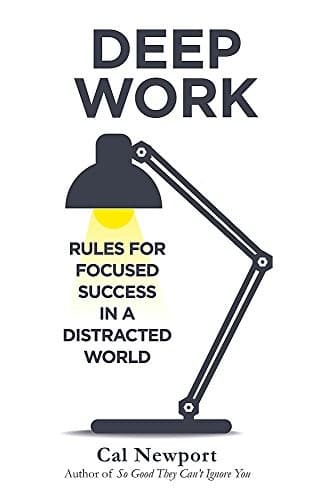
Deep Work
Cal Newport
Key Takeaways
- The Deep Work Hypothesis: The ability to perform deep work is becoming increasingly rare at exactly the same time it is becoming increasingly valuable in our economy. As a result, the few who cultivate this skill, and then make it the core of their working life, will thrive.
- Deep vs. Shallow Work: Deep work consists of professional activities performed in a state of distraction-free concentration that push your cognitive capabilities to their limit. Shallow work consists of non-cognitively demanding, logistical-style tasks, often performed while distracted.
- The Principle of Least Resistance: In a business setting, without clear feedback on the impact of various behaviors to the bottom line, we will tend toward behaviors that are easiest in the moment (like constant emailing) rather than those that are most productive.
- Attention Residue: When you switch from Task A to Task B, your attention does not immediately follow. A "residue" of your attention remains stuck on the previous task, significantly reducing your cognitive performance on the second task.
- Productive Meditation: This is the practice of taking a period in which you are occupied physically but not mentally (walking, showering, driving) and focusing your attention on a single, well-defined professional problem.
Main Ideas
The core concept of this book is that our modern work culture has prioritized "busyness" over "productivity." Cal Newport argues that to produce at your peak level, you must work for extended periods with full concentration on a single task, free from all distractions. He provides a rigorous framework for retraining your brain and restructuring your schedule to make this possible.
The New Law of Productivity
Newport introduces a simple formula: High-Quality Work Produced = (Time Spent) x (Intensity of Focus). If your intensity of focus is fragmented by notifications, "quick" email checks, or open-office noise, your output will remain mediocre regardless of how many hours you work. To thrive in the information economy, you must master the ability to learn complex things quickly and produce at an elite level.
The Four Philosophies of Deep Work
Not everyone can work in the same way. Newport outlines four different approaches to integrating deep work into your life:
1. The Monastic Philosophy
This involves maximizing deep efforts by minimizing or eliminating shallow obligations. This often means having no email and working in isolation for long periods.
2. The Bimodal Philosophy
This involves dividing your time between clearly defined deep stretches and clearly defined shallow stretches. For example, spending four days a week in total seclusion and three days open to meetings and messages.
3. The Rhythmic Philosophy
This is the most common for professionals. It involves turning deep work into a regular habit (e.g., 90 minutes every morning at 6:00 AM) to create a "rhythm" that removes the need for willpower to get started.
4. The Journalistic Philosophy
This involves fitting deep work into your schedule whenever you can find a free moment. This is only recommended for experts who can switch into a deep state instantly.
The Four Rules for Deep Work
Newport suggests that willpower is a finite resource. To save it for the work itself, you must use rituals and rules:
Rule #1: Work Deeply
You must go beyond good intentions and build "rituals" for your work. Where will you work? For how long? How will you support your work (e.g., no internet, a specific type of coffee)? You must also learn to "drain the shallows" by limiting the time you spend on low-value tasks.
Rule #2: Embrace Boredom
Retrain your brain to resist the urge for constant stimulation. If every time you feel a moment of boredom (like waiting in line), you reach for your smartphone, your brain has been "rewired" for distraction. You must practice being bored to strengthen your "concentration muscle."
Rule #3: Quit Social Media
Newport argues that we should treat our tools like a craftsman treats theirs. Only use a tool (like social media) if its positive impacts substantially outweigh its negative impacts. Most "network tools" offer minor benefits while significantly fragmenting our attention.
Rule #4: Drain the Shallows
Treat "shallow work" with suspicion. Newport suggests asking your boss for a "shallow work budget" and scheduling every minute of your day. This isn't about being a robot; it's about being intentional so you can protect the hours needed for deep, meaningful output.
The Shutdown Ritual
A critical part of the Deep Work system is the "Shutdown Ritual." At the end of the workday, you must follow a set routine to clear your "open loops" (unfinished tasks). You review your calendar, update your to-do list, and say a specific phrase (like "Shutdown complete"). This signals to your brain that it is safe to stop thinking about work, allowing for the true cognitive rest required to work deeply the following day.